Saturday, August 8, 2009

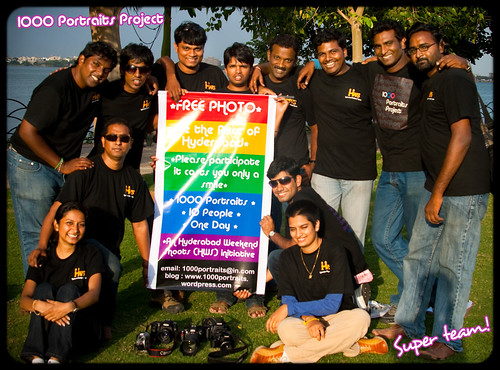
1000 Portraits Project - A great success


1000 Portraits - 10 Photographers - 1 Day - 1 City - HYDERABAD. Whenever we think of any great city, we think of the monuments, the historic places but the real essence lies in its people. The 1000 portrait project is an attempt to both salute and celebrate the people of Hyderabad.
One Day: Sunday 2Nd, August 2009
10 People: Cishore, Sekhar, Vijju, Rebel, Naveen, Ranjeeth, Chaitanya, Suraj, Preethu, Janki, Jusri, Peddu, Charu, Abhi & Kartik
1000 Portraits: www.flickr.com/groups/1000portraits/

We have started the project at Necklace road and we split into 2 groups and we started clicking. We have divided in to three categories for each group. Clickers, Snickers and Flickers. Flickers will flick the people and talk to them and make them smile. Snickers will catch , note down the details of the capture numbers and the contact details. Clickers will do the most easiest thing which is capturing & framing.. :)

We have taken ~2400 portraits in a span of 10 hours in 10 different locations and interacted more that 3000+ people. I personally had an interaction with 1600 people and got an good opportunity to explore and study emotional behaviours, facial expressions, smiles, different communication, etc. I was surprised to see that Hyderabad people are very open minded and most of them has no issues to share their smile and photographs.

Initially we had some difficulties in convincing people but when we explained about the social cause and our profiles people came forward to share their smiles. Overall this is a great experience in my life capturing 1000 portraits in one day. This is done for the first time in ASIA. This was done in UK, USA, Spain in the past and now we the "Hyderabadies" has done it. All the expenditure for this project will be shared by this 10 people just for making "Hyderabad Smile".

A exhibit on will is planned this month end and the venue will be updated shortly. You can view 1000 portraits here:

View all 1000 portraits in Flickr

For more details please visit www.1000portraits.in

Monday, April 27, 2009

When to Use Which User Experience Research Methods

Modern day user experience research methods can now answer a wide range of questions. Knowing when to use each method can be understood by mapping them in 3 key dimensions and across typical product development phases.

The field of user experience, is blessed (or cursed) with a very wide range of research methods, ranging from tried-and-true methods such as lab-based usability studies to those that have been more recently developed, such as desirability studies (to measure aesthetic appeal).
You can't use the full set of methods on every project, but most design teams benefit from combining insights from multiple research methods. The key question is what to do when. To better understand when to use which method, it is helpful to realize that they differ along 3 dimensions:
Attitudinal vs. Behavioral
Qualitative vs. Quantitative
Context of Website or Product Use The following chart illustrates where several popular methods appear along these dimensions:


More details...click here http://www.useit.com/alertbox/user-research-methods.html

Comparing UXD Business Models

This manifest need for UX leaders to learn—and share—best practices was the rationale for the authors, Jim Nieters and Garett Dworman, to write and present a CHI 2007 Experience Report on the organizational structure that Jim Nieters created for his UX group at Cisco

[1]. It also motivated us to follow up that presentation with a CHI 2007 Management Special Interest Group (SIG), “Comparing UXD Business Models,” in which participants compared different models of UX organizational design

[2]. Our intent was to share experiences and systematically explore them in the hope that this information will aid companies in structuring their internal UX functions. To this end, we generated SWOT (Strengths, Weaknesses, Opportunities, and Threats) analyses of four UX business models.

Visit: uxmatters to read the complete article

Tuesday, April 7, 2009

Just back from Adventure photography trip

We are just Back from Coorg :)
Recently back from Coorg (Kodagu) adventure photography trip with my photography friends. It was a long weekend trip a(march-27th to 29th) we planned and was a awesome experience and this reminds me for the rest of life.
That’s Coorg for me incomparable scenic beauty, lush green valleys, coffee plantations, teak wood forests & majestic mountain ranges. Add to that a strong, brave martial race of Coorgs (Kodavas) that reveres tradition, has a distinct culture and lives life to its fullest.

Coorg is situated on the Western Ghats of Karnataka in South India. For the adventurous at heart, it is an absolute treat. There are trekking, golfing and angling (Mahaseer too!) options available. Religious trips abound on Hindu and Buddhist circuits. Family getaways can be easily arranged. You can also relax your body and mind with special Ayurvedic massages. Coorg is also as trendy and happening as its close neighbour Bangalore.

But the predominant entity here is nature at its best. Coorg is like the dreamland of the philosopher. If you’re the type who likes to mingle with nature, romance in the mountains, feel the tingle of the cool and gentle breeze, watch leaves flutter in dance-like movements and hear sounds of birds fill the air, then Coorg is just the place for you!
I have of exciting experiences to share with you and will update this shortly.. Till then bye...! Come back again..!

GOOD DESIGN in 'Ten commandments’.

Back in the early 1980s, Dieter Rams was becoming increasingly concerned by the state of the world around him – “an impenetrable confusion of forms, colours and noises.” Aware that he was a significant contributor to that world, he asked himself an important question: is my design good design?
As good design cannot be measured in a finite way he set about expressing the ten most important criteria for what he considered was good design. Subsequently they have become known as the ‘Ten commandments’.
Here they are.
  • Good Design is innovative
  • Good design makes a product useful
  • Good design is aesthetic
  • Good Design helps a product tobe understood
  • Good design is unobtrusive
  • Good design is honest
  • Good design is durable
  • Good design is thorough to the last detail
  • Good design is concerned with the environment
  • Good design is a little design is possible
For more details check : http://www.vitsoe.com/en/gb/about/gooddesign
Vitsœ’s designer Dieter Rams. Photograph by Abisag Tüllmann

Wednesday, March 4, 2009

Feel proud to be a UX'er...


Usability Experience Specialist is considered as Top30 careers for 2009
Overview: This profession has a hard time agreeing on a name for itself. It's called, for example, user experience specialist, interface designer, information architect, usability practitioner, user-centered design specialist, and usability manager.

Whatever you call them, their job is to help ensure that products, especially technical ones, are easy and pleasurable to use. How? First, they observe and interview potential users to identify their needs and preferences. They may conduct a task analysis to break down the user experience of a product to its component parts and make suggestions for each. After a prototype is developed, they may watch and interview potential users again and suggest revisions. Usability specialists may work, for example, on voting machines, the next generation iPhone, a medical imaging machine, an athletic shoe production line, a shopping website, or a bricks-and-mortar store.

A potential downside of this career is that shortsighted companies believe they can make products without a specifically trained usability expert, so you may have to spend considerable time justifying your service's value. Another drawback is that you may need to make efforts to avoid being typecast as someone who can help design only one kind of product.
Those concerns are usually dwarfed by the ongoing creativity and the good feeling of continually creating products that are a pleasure to use.

A Day in the Life. Because you're the only usability specialist in your company, you're involved in all stages of the product development process. You might actually never get to participate in all aspects in one day, but here, we'll suspend that bit of reality so you can get a better idea of what the career is like.

my photostream

ranZeethT - View my flickr photo stream